Determining the Limiting Reactant and Percent Yield in a Precipitation Reaction.
The OBJECTIVES of this lab are to determine which of the reactants is the limiting reactant and which is the excess reactant; to determinr the theoretical mass of precipitate that should form; to compare the actual mass with the theoretical mass of precipitate and calculate.
The equipment we used in this lab is a little different form before, we use filtering apparatus and filter paper to filtrate the products.
There is a small tip when using filter paper: we'd better use water to wet the paper in order to let it accrete on the filtering qpparatus.
Chemical reagents we used in this lab are 25ml 0.70M sodium carbonate solution, Na2CO3 and 25ml 0.50M calcium chloride solution, CaCl2.
Na2CO3(aq) + CaCl2(aq) = 2NaCl(aq) + CaCO3 (s)
(CaCO3 is white solid)
0.7M * 0.025L*(1 mol NaCO3/1 mol CaCO3) * (100g/mol) = 1.75g CaCO3
0.5M * 0.025L*(1 mol CaCl2/ 1 mol CaCO3) *(100g/mol) = 1.25g CaCO3
Na2CO3 will be left!
So that after filtrate the solid is CaCO3, the solution is Na2CO3+NaCL
After measure, we find the product we get actually is 1.02g
% Yield = 1.02g/1.25g *100% = 0.82%
2012年3月8日星期四

Percent Yield and Purity
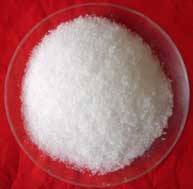 From last class, we knew that in real chemical reactions, chemicals are not always able to be recoverd, or some reactants will not use up. In that case, we are not possible to get same amount of products as we want according to equations.
So that we have to calculate % Yield!!!
% Yield = (grams of actual product recoverd) / (grams of products expected for stoich) * 100%
We also know that not all the chemicals are pure,
for instance, most of the metal in earth are exist in type of alloy.
So that we have to calculate % Purity before we solve the problems
% Purity = (Mass of pure substance) / (Mass of Impure sample) * 100%

Example: 0.1g H2 appears when sufficient Iron react with 100g HCl which the purity is 12%, what is the % Yield?
First, balance equation: Fe + 2HCl = FeCl2 + H2
100g * 12% / (36.5g/mol) * (1 mol H2/ 2 mol HCl) * 2g/ mol = 0.33g H2
% Yield = 0.1g / 0.33g * 100% = 30.3%
Excess & Limiting reactant
Excess quantity: In real chemical reactions, it is necessary to add more of the reactan than the equation predicts because it is not possible for every atom/molecular of reactants to come together.
One reactant is the excess quantity and some of it will be left over. The second reactant is used up completely.

When dealing with this kind of problems, having a correctly balanced equation is always important.
Because it will give a prediction and with that, you can find how much chemical left.
Example: Which chemical will left when 20g Mg react with 10g HCl and how much will left?
First, give a correctly balanced equation: Mg +2 HCl == MgCl2 + H2
1 mol Mg can make 1 mol H2;
2 mol HCl can make 1 mol H2.
20g/(24.3g/mol)*(1 mol H2/ 1 mol Mg) = 0.82 mol H2 = 1.64g H2
10g/(36.5g/mol)*(1 mol H2/2 mol HCl) = 0.14 mol H2= 0.28g H2
At that time, we can clearly see that 20g Mg can make more H2, so that Mg will be left and O2 is going to be used up.
But how much Mg will left?
0.14 mol H2 * (1 mol Mg/ 1 mol H2) * 24.3g/mol = 3.4g
20g-3.4g = 16.6 g Mg left
One reactant is the excess quantity and some of it will be left over. The second reactant is used up completely.
When dealing with this kind of problems, having a correctly balanced equation is always important.
Because it will give a prediction and with that, you can find how much chemical left.
Example: Which chemical will left when 20g Mg react with 10g HCl and how much will left?
First, give a correctly balanced equation: Mg +2 HCl == MgCl2 + H2
1 mol Mg can make 1 mol H2;
2 mol HCl can make 1 mol H2.
20g/(24.3g/mol)*(1 mol H2/ 1 mol Mg) = 0.82 mol H2 = 1.64g H2
10g/(36.5g/mol)*(1 mol H2/2 mol HCl) = 0.14 mol H2= 0.28g H2
At that time, we can clearly see that 20g Mg can make more H2, so that Mg will be left and O2 is going to be used up.
But how much Mg will left?
0.14 mol H2 * (1 mol Mg/ 1 mol H2) * 24.3g/mol = 3.4g
20g-3.4g = 16.6 g Mg left
Stoichiometry calculation
In summary, stoichiometry is the study of quantitive aspect of chemical reaction.
When dealing with the stoichiometry calculations, first of all, you have to get a correctly balanced equation. The number in front of each reactants and products means the quantity of each chemicals in the reaction. Then, we can solve the Stoichiometry problems through the ratio of each chemicals.

Example : How many moles of H2 can we get when 20g Iron react with sufficient HCl?
First, we write the eaqution and balance it:
1 Fe(s) + 2 HCl(aq) == 1 FeCl2(aq) + 1 H2(gas)
Second, we change 20g Iron into moles:
the mole mass of iron is 56g/mol.
20g/(56g/mol)=0.36mol iron
according to the banlanced eqution we made before: 1 mol Fe can make 1 mole H2
So that 0.36 mol/ (1 mol H2/ 1 mol Fe)= 0.36mol H2
We can get 0.36 mol H2 when 20g Iron react with sufficient HCl
Hint: through the balanced equation, we can directly get the ratio of Fe and H2= 1:1.
When dealing with the stoichiometry calculations, first of all, you have to get a correctly balanced equation. The number in front of each reactants and products means the quantity of each chemicals in the reaction. Then, we can solve the Stoichiometry problems through the ratio of each chemicals.
Example : How many moles of H2 can we get when 20g Iron react with sufficient HCl?
First, we write the eaqution and balance it:
1 Fe(s) + 2 HCl(aq) == 1 FeCl2(aq) + 1 H2(gas)
Second, we change 20g Iron into moles:
the mole mass of iron is 56g/mol.
20g/(56g/mol)=0.36mol iron
according to the banlanced eqution we made before: 1 mol Fe can make 1 mole H2
So that 0.36 mol/ (1 mol H2/ 1 mol Fe)= 0.36mol H2
We can get 0.36 mol H2 when 20g Iron react with sufficient HCl
Hint: through the balanced equation, we can directly get the ratio of Fe and H2= 1:1.
订阅:
评论 (Atom)